

Courses
MYVI delivers Australian and Asian accredited hospitality courses from Certificate I through Certificate IV and Diploma level, alongside Bakery, English language, and Computer Skills programmes across our four campuses.
Content to be supplied.
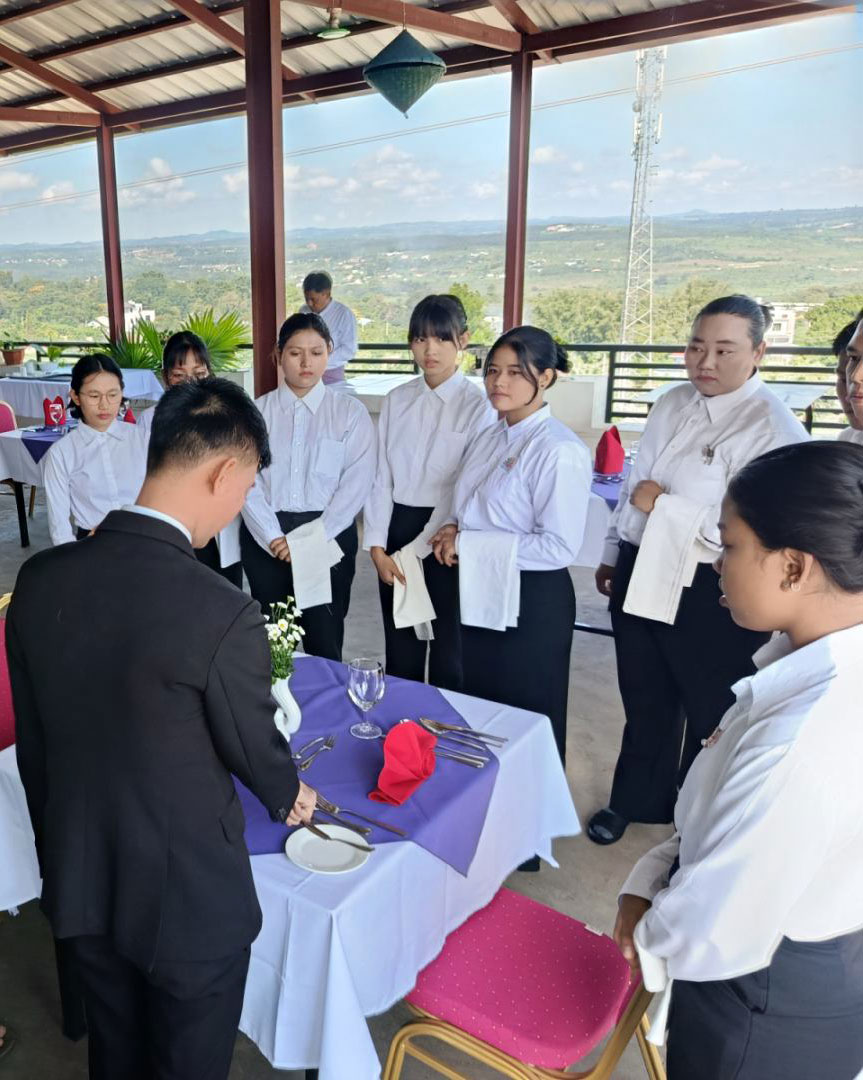

Course Overview
This qualification prepares students for entry-level roles in commercial kitchens. Learners develop foundational food preparation skills, basic cookery techniques, and the ability to perform routine kitchen tasks under direct supervision.
Note: This qualification does not provide trade recognition as a qualified cook. It serves as a pathway towards further cookery training.
Career Pathways
Graduates may gain entry-level employment in:
- Restaurants
- Hotels
- Cafés & Coffee Shops
- Catering Operations
- Clubs & Pubs
- Aged Care Facilities
- Hospitals
- Schools & Other Institutions
Entry Requirements
There are no entry requirements for this qualification.
Course Structure
To achieve this qualification, students must complete 13 units: 7 Core Units (delivered in line with industry standards, legislation, and food safety requirements) and 6 Elective Units.
Electives may include: Cookery & Catering, Asian Cookery, Patisserie, and General Electives (e.g., First Aid, Customer Service).
Core Skill Areas
Students will develop skills in:
- Using food preparation equipment
- Preparing dishes using basic cookery methods
- Working effectively in a commercial kitchen
- Food safety and hygienic practices
- Stock control
- Safe work practices
Nationally Recognised Qualification
Qualification Description
The SIT30821 Certificate III in Commercial Cookery reflects the role of cooks who use well-developed cookery skills and strong knowledge of kitchen operations to prepare food and menu items. Graduates demonstrate discretion and judgement, working with some independence and under limited supervision while following established plans, policies, and procedures.
Completion of this qualification contributes to trade recognition as a cook. This certificate provides a pathway to employment in a wide range of food service and hospitality environments, including restaurants, hotels, clubs, pubs, cafés, and coffee shops.
All skills must be applied in accordance with Commonwealth and State/Territory legislation, Australian Standards, and industry codes of practice. There are no licensing or certification requirements for this qualification.
Entry Requirements
There are no formal entry requirements for this qualification.
Career Outcomes
Graduates may work as:
- Commercial Cooks
- Café or Bistro Cooks
- Hotel or Club Cooks
- Catering Cooks
- Functions and Banqueting Cooks
- Institutional Cooks (aged care, hospitals, schools)
Course Structure
To achieve the SIT30821 Certificate III in Commercial Cookery, students must complete a total of 25 units: 20 Core Units and 5 Elective Units.
Elective units must consist of 3 units from Group A or Group B, and 2 units from Group A, Group B, or Group C. All electives must contribute to a valid, industry-supported vocational outcome. Units marked with an asterisk have prerequisites.
Core Units (20)
- SITHCCC023* — Use food preparation equipment
- SITHCCC027* — Prepare dishes using basic methods of cookery
- SITHCCC028* — Prepare appetisers and salads
- SITHCCC029* — Prepare stocks, sauces and soups
- SITHCCC030* — Prepare vegetable, fruit, eggs and farinaceous dishes
- SITHCCC031* — Prepare vegetarian and vegan dishes
- SITHCCC035* — Prepare poultry dishes
- SITHCCC036* — Prepare meat dishes
- SITHCCC037* — Prepare seafood dishes
- SITHCCC041* — Produce cakes, pastries and breads
- SITHCCC042* — Prepare food to meet special dietary requirements
- SITHCCC043* — Work effectively as a cook
- SITHKOP009* — Clean kitchen premises and equipment
- SITHKOP010 — Plan and cost recipes
- SITHPAT016* — Produce desserts
- SITXFSA005 — Use hygienic practices for food safety
- SITXFSA006 — Participate in safe food handling practices
- SITXHRM007 — Coach others in job skills
- SITXINV006* — Receive, store and maintain stock
- SITXWHS005 — Participate in safe work practices
Elective Units
Group A — Cookery & Catering
- SITHCCC025* — Prepare and present sandwiches
- SITHCCC026* — Package prepared foodstuffs
- SITHCCC032* — Produce cook-chill and cook-freeze foods
- SITHCCC033* — Re-thermalise chilled and frozen foods
- SITHCCC038* — Produce and serve food for buffets
- SITHCCC039* — Produce pates and terrines
- SITHCCC040* — Prepare and serve cheese
- SITHCCC044* — Prepare specialised food items
- SITHPAT014* — Produce yeast-based bakery products
- SITXFSA007* — Transport and store food
Group B — Asian Cookery
- SITHASC020* — Prepare dishes using basic methods of Asian cookery
- SITHASC021* — Prepare Asian appetisers and snacks
- SITHASC022* — Prepare Asian stocks and soups
- SITHASC023* — Prepare Asian sauces, dips and accompaniments
- SITHASC024* — Prepare Asian salads
- SITHASC025* — Prepare Asian rice and noodles
- SITHASC026* — Prepare curry pastes and powders
- SITHASC027* — Prepare Asian cooked dishes
- SITHASC028* — Prepare Asian desserts
- SITHASC033* — Prepare dim sum
Group C — General Electives
- BSBSUS211 — Participate in sustainable work practices
- HLTAID011 — Provide First Aid
- SIRXOSM002 — Maintain ethical and professional standards when using social media
- SIRXOSM003* — Use social media and online tools
- SITXCCS014 — Provide service to customers
- SITXCOM006 — Source and present information
- SITXCOM007 — Show social and cultural sensitivity
- SITXINV007 — Purchase goods
- SITXWHS006 — Identify hazards, assess and control safety risks

Qualification Overview
The SIT40412 Certificate IV in Commercial Cookery reflects the role of commercial cooks who take on supervisory or team-leading responsibilities in professional kitchen environments. Learners operate independently or with limited guidance, using discretion and judgement to solve non-routine problems in the kitchen.
This qualification is suitable for individuals looking to advance their culinary skills and step into leadership roles within diverse hospitality settings.
Career Outcomes
Graduates may work in a variety of commercial kitchen environments, including restaurants, hotels, clubs and pubs, cafés and coffee shops, and cafeterias. Possible job titles include Chef and Chef de Partie.
Pathways
Entry is open to individuals with limited or no vocational experience. However, it is strongly recommended that learners complete lower-level cookery or hospitality qualifications and/or gain industry experience before enrolling.
After completing this qualification, learners may progress to the SIT50312 Diploma of Hospitality. This qualification is also suitable for an Australian Apprenticeship pathway.
Entry Requirements
There are no formal entry requirements for this qualification. There are no licensing, legislative, or certification requirements for this qualification at the time of endorsement.
Employability Skills Summary
|
Skill Area |
Key Capabilities |
|
Communication |
Leading food production briefings; providing and receiving feedback; communicating changes during service; managing conflict sensitively; guiding staff to meet quality standards |
|
Initiative & Enterprise |
Suggesting operational improvements; providing feedback for future planning; supporting continuous improvement; identifying new product and menu opportunities |
|
Learning |
Staying updated on food trends; participating in professional development; supporting team learning |
|
Planning & Organising |
Planning food production and supply needs; developing workflow schedules and mise en place plans; monitoring kitchen operations for quality and efficiency |
|
Problem-Solving |
Identifying and resolving kitchen issues; taking short-term corrective action; applying judgement within policies and procedures |
|
Self-Management |
Applying food safety and WHS practices; managing own work priorities; leading and managing kitchen teams; seeking feedback for performance improvement |
|
Teamwork |
Motivating and guiding kitchen staff; providing coaching and support; planning work based on team strengths; sharing knowledge and experience |
|
Technology |
Selecting and operating kitchen tools and equipment; using kitchen management systems and relevant software |
The Diploma in Hospitality Management is a nationally aligned, internationally benchmarked programme designed to prepare competent, ethical, and job-ready professionals for the growing hospitality and tourism industry. This programme aligns with the Australian Qualifications Framework (AQF) at Diploma (Level 5 equivalent).
Programme Overview
| Field | Detail |
| Qualification Title | Diploma in Hospitality Management |
| Level | Diploma (AQF-aligned / Level 5 equivalent) |
| Duration | 12 Months |
| Theory & Practical | 6 Months Classroom Theory & Practical Training |
| Industry Internship | 6 Months Supervised Industry Internship |
| Total Learning Hours | 1,200 Hours (Theory: 480 | Practical/Simulation: 420 | Internship: 300) |
| Mode | Blended (Classroom, Practical Training, Workplace Learning) |
| Target Learners | School leavers, existing hospitality workers seeking formal certification, and underprivileged youth seeking employability pathways |
Why This Programme?
The Diploma in Hospitality Management is designed to meet labour-market needs by combining solid theoretical understanding, hands-on practical skills, real-world internship experience, and alignment with international competency standards. Graduates will be prepared for employment in hotels, resorts, restaurants, tourism services, and various hospitality establishments.
Programme Objectives
Learners will develop the ability to:
- Deliver professional hospitality service across departments
- Manage front office, housekeeping, and food & beverage operations
- Demonstrate strong teamwork, leadership, and customer service
- Apply basic accounting, cost control, marketing, and operational principles
- Uphold food safety, hygiene, and workplace health and safety standards
- Communicate confidently in professional hospitality settings
Learning Outcomes
Upon successful completion, graduates will be able to:
- Perform core operational tasks in major hospitality departments
- Apply excellent customer service principles
- Manage daily hospitality operations ethically and efficiently
- Communicate professionally with guests and colleagues
- Demonstrate problem-solving and decision-making skills
- Exhibit strong employability and workplace readiness
Programme Structure
| Phase | Description |
| Phase 1: Foundation & Core Skills (Weeks 1–12) | Hospitality fundamentals, customer service, WHS, and food safety |
| Phase 2: Departmental Operations (Weeks 13–24) | Front office, housekeeping, F&B operations, basic accounting |
| Phase 3: Supervisory & Management Skills (Weeks 25–36) | Leadership, supervision, communication, quality assurance, revenue concepts |
| Phase 4: Industry Internship (Weeks 37–52) | Supervised workplace training with formal assessment |
Core Course Modules
- Introduction to Hospitality Industry
- Professional Customer Service Excellence
- Food & Beverage Operations
- Front Office Operations
- Housekeeping Operations
- Food Safety & Hygiene Practices
- Workplace Health & Safety (WHS)
- Hospitality Communication Skills
- Hospitality Accounting & Cost Control
- Sales & Marketing for Hospitality
- Human Resource Practices in Hospitality
- Leadership & Supervisory Skills
Teaching & Learning Methods
- Interactive lectures
- Demonstrations and simulations
- Role-plays and case studies
- Practical lab sessions
- Guest lectures from industry professionals
- Workplace-based learning
Entry Requirements
- Minimum age: 18
- Basic literacy and numeracy
- Interest in hospitality
- English competency
Other Programmes
Bakery is taught at Sanon (Bagan), Envision (Pyin Oo Lwin), and Char Thar Kon.
English is taught at all campuses. Pre-course English classes are made available to students who wish to take advanced courses where a high level of English is essential to enter and pass.
Computer Skills are taught as part of most courses and can also be taken separately.
Course Information
- Course structure varies by qualification — see individual course pages above.
- Entry requirements: Cert I, II, III and IV have no formal entry requirements (prior experience recommended for Cert III and above). Diploma requires minimum age 18, basic literacy and numeracy, English competency, and an interest in hospitality.
- Fees are payable for all students who do not meet the scholarship criteria.
- Scholarships are available to students who meet the criteria of the scholarship application form.
Career Outcomes
All students who pass MYVI courses have a better than average chance of employment. Those who achieve Level 4 and Diploma level have far greater opportunities. In the hospitality industry, opportunities increase with both the level of training and the level of English — a combination of both is needed to succeed.